Leather Jacket Mens
Men's Distressed Leather Trench Coat: Pull-Up Oil-Tanned Cowhide, Long Vintage Silhouette
Men's Distressed Leather Trench Coat: Pull-Up Oil-Tanned Cowhide, Long Vintage Silhouette
Couldn't load pickup availability
A men's distressed leather trench coat is a long outerwear piece made from intentionally aged or specially processed leather. The most commonly pulled-up oil-tanned, wax-aged, or drum-tumbled cowhide that produces a worn, vintage aesthetic through natural finish techniques rather than synthetic coatings. The distressed surface develops visible color variation, scuff marks, and character with use, intensifying over time into a finish that looks uniquely personal.
Some coats look new. This one looks lived in from the moment you put it on.
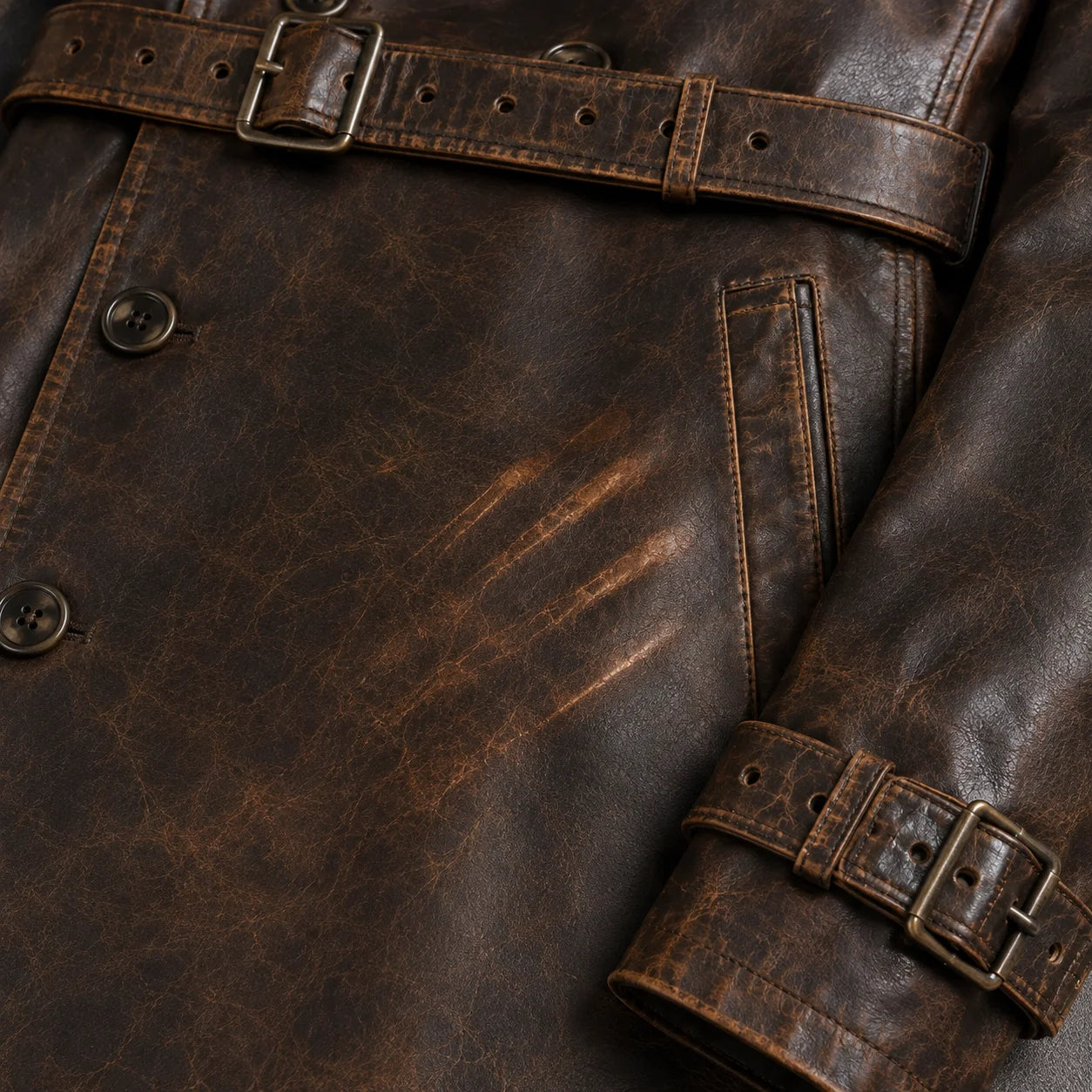
Pull-up oil-tanned leather is processed by saturating the hide with natural oils and waxes rather than surface dyes or synthetic coatings. The result is a leather that shows every fold, every scuff, every raindrop not as damage, but as record. Drag your thumbnail across the surface, and the color lightens immediately. Release pressure, and it slowly deepens back. That reactive quality is what makes pull-up leather unlike anything else in outerwear.
This coat is built from 1.1mm pull-up oil-tanned cowhide in dark brown. The long silhouette hits below the knee. The belt cinches at the waist. The lapels are wide and unstructured. The leather drapes rather than holds a rigid line, which is exactly how a distressed coat should move.
It doesn't look like it just arrived from a warehouse. It looks like it belongs to someone.
The Pull-Up Oil Tanning Process - What Creates the Distressed Effect
Most leather on the market is finished with surface dyes, pigment coatings, or synthetic lacquers applied after tanning. Those coatings produce uniform color and a polished appearance - but they also seal the leather surface, preventing the reactive, living quality that serious leather buyers want.
Pull-up oil-tanned leather takes a completely different approach. Here's how it works:
The Distress Finish Classification - 5 Techniques Compared
|
Finish Type |
Tanning Method |
Visual Effect |
Reactivity |
Patina Speed |
|---|---|---|---|---|
|
Pull-Up Oil Tanned |
Saturated with natural oils + waxes |
Color lightens under pressure, deepens on release |
★★★★★ |
Fast - visible within weeks |
|
Wax-Aged |
Surface wax applied post-tan |
Matte, chalky surface with rub-through color |
★★★★☆ |
Medium - 1–3 months |
|
Hand-Sanded |
Physical abrasion of surface grain |
Buffed, worn appearance at grain peaks |
★★★☆☆ |
Slow - subtle over years |
|
Drum-Tumbled |
Mechanical tumbling during tanning |
Soft, pebbled texture with natural crease marks |
★★★☆☆ |
Medium - natural with use |
|
Vintage Burnished |
Heat + pressure applied selectively |
Dark edges, lighter centers - antiqued effect |
★★☆☆☆ |
Very slow - stable finish |
Pull-up oil tanning produces the most reactive and visually dynamic finish of the five. It's the technique used in heritage boot making. Brands like Red Wing and Whites Boots have built entire reputations on pull-up leather's aging behavior. Applied to a long trench silhouette, the effect is dramatic. For background on the tanning process itself and on vegetable tanning and oil saturation standards, see these references.
The dark brown base color reveals a cognac-amber undertone wherever the leather flexes or contacts a surface. Belt creases. Shoulder rolls. Lapel folds. Each one marks a slightly different shade. After six months of regular wear, no two coats look alike.
Construction Specs
Full Material & Build Breakdown
|
Spec |
Detail |
|---|---|
|
Hide Type |
Pull-Up Oil-Tanned Cowhide |
|
Hide Thickness |
1.1mm |
|
Hide Weight |
3.8 oz / sq ft |
|
Finish |
Pull-Up Oil Tanned - Natural Distressed |
|
Color |
Dark Brown (cognac pull-up undertone) |
|
Closure |
Double-Breasted, 6-Button Front |
|
Collar |
Wide Unstructured Peak Lapel |
|
Belt |
Adjustable D-Ring Waist Belt |
|
Lining |
Full Viscose - Dark Brown |
|
Pockets |
2 Slash Exterior + 2 Interior |
|
Length |
Below-Knee (approx. 46–48") |
|
Hardware |
Antique Brass - Slightly Aged |
|
Fit |
Relaxed, Long Silhouette |
|
Sizes |
XS – 4XL |
At 1.1mm, this hide is slightly lighter than the 1.2mm full-grain used in the black and brown classic trenches. That's intentional. A distressed coat in a longer silhouette needs to drape - 1.2mm holds a rigid line, which works for structured tailored outerwear but fights the relaxed, worn character of a pull-up oil-tanned piece. At 1.1mm the coat moves with you.
The antique brass hardware is sourced to match the aged aesthetic of the hide, not polished bright brass, not matte black, but slightly oxidized yellow-gold that sits correctly against a dark brown distressed surface.
How to Style a Men's Distressed Leather Trench Coat
The distressed finish changes the styling equation. This coat has inherent visual noise: the color variation, the reactive surface, the long silhouette. Everything underneath needs to be quieter. See our broader guide on how to wear a leather trench coat in 2026 for more pairing ideas.
Urban Streetwear
All black underneath. Black heavyweight crewneck, black slim jeans, black leather boots with a substantial sole. The dark brown distressed trench over a full-black base creates a contrast that reads intentional and considered rather than accidental. Belt it loosely at the waist - let the coat move rather than cinching it tight.
Vintage & Off-Duty
Olive or khaki cargo trousers, a faded band or graphic tee, worn leather boots or white leather sneakers. The distressed coat anchors an otherwise casual outfit with visual weight. Wear it open. The long silhouette works better unbelted in casual contexts - the drape of the pull-up leather does the work.
Layered Cold-Weather
Heavy flannel shirt over a thermal base layer, dark denim, lug-sole boots. This coat's 1.1mm hide won't insulate like the shearling trench - but layered over substantial knitwear, it covers the 35–50°F range cleanly. The unstructured lapels fold up against the neck naturally without hardware holding them in place. For genuinely cold climates, our men's shearling leather trench coat is the better-suited option.
What "Distressed" Actually Means - And What It Doesn't
There's a version of "distressed leather" sold in the fast-fashion market that's worth identifying clearly: a split-hide or bonded leather shell with artificial scuff marks printed or embossed on the surface. It looks aged on day one. It still looks the same - or worse - on day 365, because there's no living hide beneath the finish to develop further.
Pull-up oil-tanned cowhide is the opposite. The distressed quality is not applied - it's inherent to the tanning process. Scratch it, fold it, wear it in the rain, leave it in a bag - each event adds to the surface record rather than degrading it. The coat that looked characterful when you bought it looks extraordinary after two years of actual use.
This is the difference between manufactured aging and earned aging. One is aesthetic. The other is material.
The Cultural Context - Why This Silhouette Resonates
The long distressed leather trench has a specific cultural weight in the US market that goes beyond fashion. For the full lineage of the silhouette, see the history of the leather trench coat.
It's the coat Keanu Reeves wore in The Matrix - long, black, structured chaos. It's Rorschach's coat in Watchmen - the distressed brown leather that looked like it had survived the same world the character had. It's the Aiden Pearce silhouette from Watch Dogs - urban, tactical, underground. It's the Western duster updated for city streets.
None of those references are accidental. The long distressed leather trench projects a specific kind of authority - not corporate, not formal, not borrowed from traditional menswear. It's the outerwear of people who operate outside the standard rulebook.
That cultural resonance translates directly to US buyer intent. Searches for "distressed leather trench coat men," "Watchmen Rorschach coat," and "Matrix Neo coat" cluster around the same product category. This coat serves the buyer who knows exactly what they're looking for - and has been looking for a version that's actually built from real leather.
Fit Guide
This coat runs in a relaxed, long silhouette - different from the slim-tailored fit of the black and brown classics.
- Slim builds: True to size. The relaxed cut gives you room to layer without looking overwhelmed by the coat.
- Athletic builds: True to size or size up one. The unstructured lapels and relaxed shoulders accommodate broad frames better than a slim-tailored coat.
- Broader frames: True to size. The long silhouette and wide lapels are proportionally flattering on larger builds - this coat scales up well.
- Height considerations: The below-knee length (46–48") works best on men 5'9" and above. At 5'8" and under, consider whether the length serves your proportions - or look at our knee-length classic trenches.
The size chart is on the listing. For this coat specifically, fit through the shoulders is the priority measurement - the relaxed waist has the D-ring belt for adjustment, but shoulder seams on leather cannot be altered.
Lambskin Care; Precision Maintenance for Premium Hide
Oil-Tanned Leather Care - Simpler Than You Think
Pull-up oil-tanned leather is the most forgiving leather type to maintain. The oils already saturated into the hide mean it's naturally conditioned from the inside out. External conditioning extends that baseline - see our full leather trench coat care guide for the complete protocol.
- Condition once per year - not twice. Over-conditioning pull-up leather can darken the surface unevenly. Use a neutral leather conditioner applied sparingly with a soft cloth.
- Let rain dry naturally - pull-up hide absorbs water differently than full-grain. After rain exposure, the surface will darken temporarily and return to base color as it dries. This is normal. Don't panic, don't heat-dry.
- Embrace the scuffs - minor surface scratches on pull-up leather rub out with a fingertip. The oils redistribute. This is a feature, not a flaw.
- Store on a wide padded hanger - the below-knee length needs a hanger with enough shoulder width to support the coat's weight without pulling the shoulder seams.
- No saddle soap on pull-up - saddle soap strips the oils that define the finish. Use a dedicated leather cleaner if needed, applied lightly.
Frequently Asked Questions
What is pull-up oil-tanned leather?
What is pull-up oil-tanned leather?
Pull-up oil-tanned leather is cowhide processed by saturating the hide with natural oils and waxes rather than surface dyes or synthetic coatings. When pressure is applied - a scratch, a fold, a scuff - the oils displace, and the color lightens. When pressure is released, the oils redistribute, and the color deepens back. This reactive quality produces the visible, living character that defines the distressed aesthetic.
Will the distressed marks get worse over time or better?
Will the distressed marks get worse over time or better?
Better. Pull-up oil-tanned leather develops increased character with use. Scuffs accumulate into a complex patina. Color variation between wear points and the resting surface deepens. After 12–24 months of regular wear, the coat has a surface record that looks intentional and expensive - because the material itself is responsible, not artificial aging techniques.
Is this coat appropriate for formal or business settings?
Is this coat appropriate for formal or business settings?
The distressed finish and relaxed long silhouette position this coat in streetwear, smart-casual, and creative professional contexts. It is not a formal business coat. For professional environments, the Men's Black Leather Trench Coat or Men's Brown Leather Trench Coat are the correct choices.
How is pull-up leather different from genuine leather?
How is pull-up leather different from genuine leather?
Pull-up leather is full or top-grain cowhide processed with natural oils - it retains the hide's structural integrity and develops character with age. Genuine leather is a lower-grade classification that often uses inner hide layers with surface coatings. Pull-up leather improves with use. Genuine leather typically degrades from the surface coating outward over 2–4 years.
Can I wear this coat in the rain?
Can I wear this coat in the rain?
Yes, with awareness. The oil saturation in pull-up hide provides natural moisture resistance. The surface will visibly darken when wet and return to base color as it dries - this is normal and not damage. Avoid prolonged rain saturation. After heavy exposure, let the coat dry at room temperature before storing.
What makes this different from cheap "distressed" leather coats?
What makes this different from cheap "distressed" leather coats?
Budget distressed coats use bonded or split leather shells with artificial aging printed or embossed on the surface. The distressed appearance is static - it looks the same on day one and day 365, or worse if the surface coating peels. This coat uses pull-up oil-tanned cowhide where the distressed quality is inherent to the tanning process. The aging is dynamic - it evolves with actual wear into something genuinely personal.
Does this coat come in black?
Does this coat come in black?
This product is available in dark brown pull-up oil-tanned cowhide. For a black long leather coat, see our Men's Black Leather Trench Coat in full-grain cowhide.
$299 - The Price of Real Oil-Tanned Construction
Pull-up oil-tanned leather costs more to produce than corrected-grain or genuine leather at equivalent thicknesses. The oil saturation process is slower, the hides require more processing time, and the finish is more sensitive to quality control - a poorly saturated hide produces uneven color rather than dynamic variation. At $299, this coat is priced at the lower end of what serious oil-tanned leather construction retails for. Heritage boot brands charge $350–$500 for a single pair of oil-tanned leather boots at similar hide quality. A full-length trench coat requiring significantly more hide square footage at the same price is the correct comparison - not a $150 bonded leather coat from a fast-fashion retailer. What you're paying for is a coat that earns its character rather than wearing one that was printed on it.
For a softer, more refined alternative, see our men's lambskin leather trench coat.
Share