Leather Jacket Mens
Men's Brown Leather Trench Coat: Full-Grain Cowhide, Classic Belted Fit
Men's Brown Leather Trench Coat: Full-Grain Cowhide, Classic Belted Fit
Couldn't load pickup availability
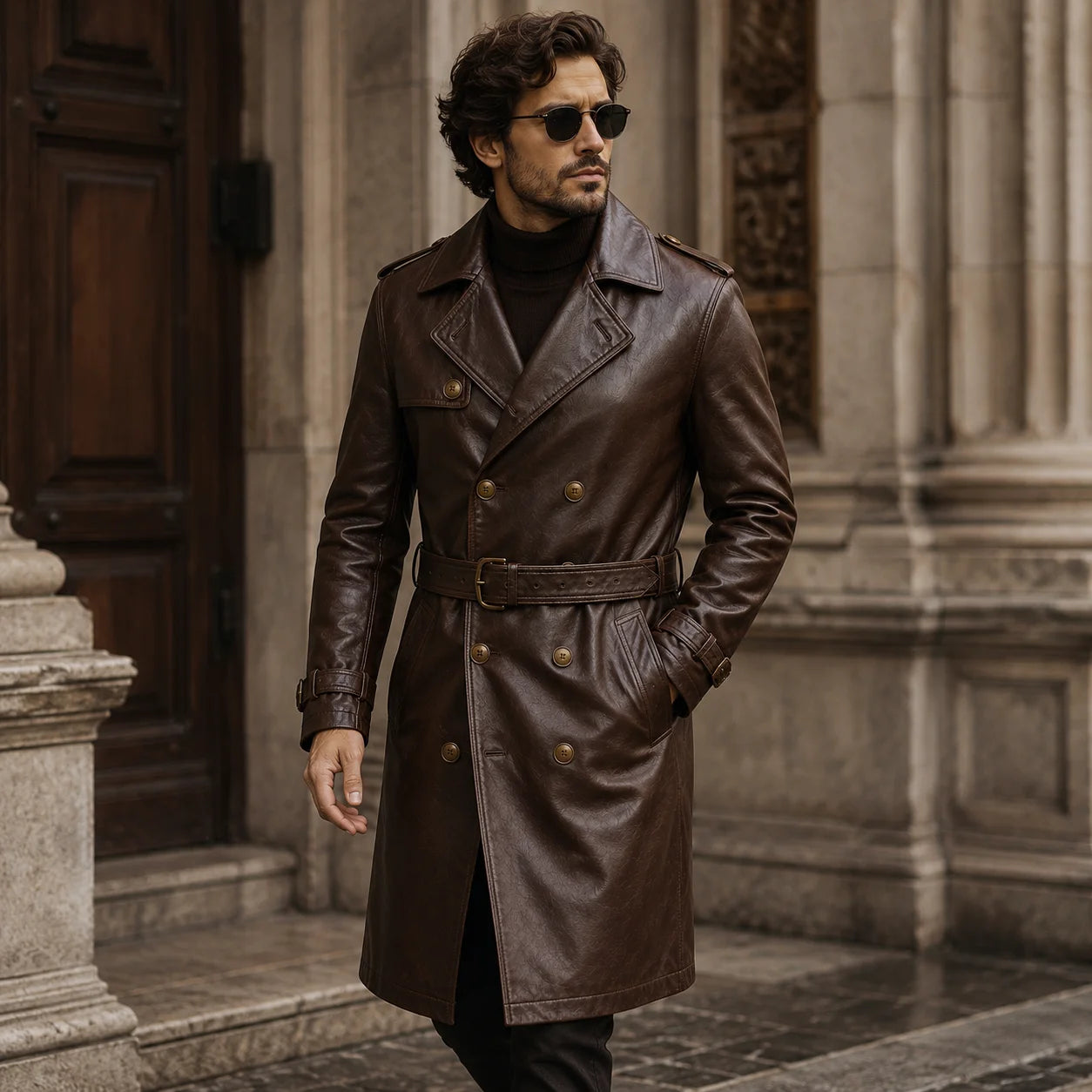
A men's brown leather trench coat is a long or knee-length outerwear piece made from full-grain or top-grain cowhide in dark brown, cognac, or chocolate tones. It features a belted waist, wide lapel collar, and a structured silhouette. Brown full-grain leather develops a natural patina with wear, deepening in color and character over years of use; making it a long-term wardrobe investment rather than a seasonal buy.
Black is the Statement. Brown is the Character.
There's a reason serious leather buyers often gravitate to brown after their first black coat. Dark brown full-grain cowhide starts rich and gets richer. The surface responds to light differently depending on the hour; almost amber at dusk, deep espresso under office fluorescents. You're not just buying a coat. You're buying something that gets better the more you ignore caring for it perfectly.
This coat is built on 1.2mm full-grain cowhide. The belted waist is adjustable, the double-breasted front closes clean, and the viscose lining sits against your mid-layers without bunching. Functional. Sharp. Zero gimmicks.
Why Dark Brown Full-Grain Leather Ages Better Than Any Other Finish
Full-grain leather in dark brown tones develops a patina faster and more visibly than black. Because the natural hide color is closer to the surface. Pull-up leather, in particular, shows color variation at flex points immediately, deepening into a two-tone effect that looks intentional and expensive.
This is the Patina Projection Scale for dark brown full-grain cowhide:
|
Timeframe |
What Happens to the Hide |
|
Month 1 |
Surface color is uniform. Leather is firm, holds structured shape. |
|
Month 2–4 |
Flex points, elbows, shoulders, belt line begin lightening slightly. |
|
Month 4–8 |
Two-tone effect emerges. Wear points show a cognac pull-up beneath dark surface. |
|
Year 1 |
Full character begins. Leather softens noticeably, conforms to body. |
|
Year 2–3 |
Patina is rich, complex, unmistakably yours. No two coats age identically. |
|
Year 5+ |
The coat looks like it cost twice what you paid and fits better than day one. |
Black leather develops a patina, too but it's subtle. Dark brown makes that progression visible, tactile, something you notice each time you put the coat on.
Construction Specs
Full Material & Build Breakdown
|
Spec |
Detail |
|
Hide Type |
Full-Grain Cowhide |
|
Hide Thickness |
1.2mm |
|
Hide Weight |
4.2 oz / sq ft |
|
Color |
Dark Brown |
|
Closure |
Double-Breasted, 6-Button Front |
|
Collar |
Wide Peak Lapel |
|
Belt |
Adjustable D-Ring Waist Belt |
|
Lining |
Full Viscose Satin |
|
Pockets |
2 Slash Exterior + 2 Interior |
|
Length |
Knee-Length (approx. 42–44") |
|
Hardware |
Antique Brass Buttons |
|
Fit |
Structured, Slim-Tailored |
|
Sizes |
XS – 4XL |
The 1.2mm hide sits at the intersection of structure and wearability; stiff enough to hold the trench silhouette without shoulder padding, light enough that you're not carrying the coat on your frame. It's the same thickness range you'll find on coats retailing at double this price point from heritage outerwear brands.
How to Style a Men's Brown Leather Trench Coat
Brown leather is more versatile than most men realize. It reads warmer than black without being casual and pairs with a wider range of base colors.
Business & Smart-Casual
Wear it over a cream or ivory dress shirt with dark navy trousers and tan leather oxfords. The brown-tan-navy palette is one of the strongest combinations in men's tailoring. Let the coat hang open at the lapel. The wide peak collar does the framing.
Weekend & Off-Duty
Throw it over a heavyweight oatmeal crewneck and dark brown or black raw denim. Brown leather and earth-toned knitwear work together without effort. Add desert boots or tan leather Chelsea boots and the look is complete. This is the outfit that earns unsolicited compliments.
Autumn Layering
Full-grain cowhide at 1.2mm cuts wind effectively in the 35–55°F range. For colder days, layer a mid-weight merino turtleneck underneath. The structured shoulders accommodate it cleanly. Belt the waist over the outer coat to keep the silhouette defined rather than shapeless.
Brown vs. Black: Choosing the Right Leather Trench
Not a question of which is better. A question of what you're building in your wardrobe.
|
Brown Leather Trench |
Black Leather Trench |
|
|
Patina Visibility |
High color shift visible within months |
Low subtle deepening over years |
|
Styling Range |
Earth tones, navy, cream, olive |
Monochrome, grey, charcoal, white |
|
Formality Level |
Business-casual to smart-formal |
Business-formal to streetwear |
|
Perceived Warmth |
Warmer, more approachable |
Sharper, more authoritative |
|
Uniqueness |
Higher patina makes each coat individual |
Lower patina is less visible |
|
Best Season |
Autumn / Winter |
Year-round |
If you own one leather trench, black is the default. If you're building a collection — or if you want something that grows with you — brown is the correct second coat. Or first, if you know what you're doing.
Fit Guide
The slim-tailored silhouette on this coat follows the same sizing logic as Product 1. The belted waist is adjustable — which gives you more latitude than a fixed-seam waist on most coats.
- Slim builds: True to size. The adjustable belt defines the waist cleanly.
- Athletic builds: Size up one. Use the D-ring belt loosened one notch for shoulder freedom.
- Broader frames: Size up one and wear open. The wide lapels work well without the belt cinched.
Full size chart is on the product listing. Measure chest and cross-reference. Leather doesn't stretch.
Leather Care for Brown Cowhide
Dark brown full-grain cowhide is slightly more forgiving than black in terms of showing scuffs and water spots. The natural variation in tone absorbs minor marks better. That said, a basic care protocol protects the hide and accelerates the patina development correctly.
- Condition every 6 months — use a colorless leather conditioner to avoid tonal shift. Bickmore Bick 4 or Leather Honey work well on dark brown.
- Apply a brown leather cream once a year to maintain color depth, particularly at wear points where patina lightens the surface.
- Wipe dry after rain — dark brown hides water marks less visibly than black, but let the hide dry naturally before conditioning.
- Store on a padded hanger — wide-base wooden or padded shoulder hanger only. Wire deforms the structured shoulders.
- Keep away from direct heat — radiators and direct sunlight dry the hide and cause uneven fading.
The patina you're building with this coat is a 5-year project. The care routine takes 30 minutes per year. Worth it.
Frequently Asked Questions
Is this brown leather trench coat real leather or synthetic?
Is this brown leather trench coat real leather or synthetic?
This is 100% full-grain cowhide, not faux leather, PU, or bonded leather. Full-grain is the highest leather grade, using the complete outer hide surface without sanding or artificial correction.
Will the dark brown color fade over time?
Will the dark brown color fade over time?
The hide doesn't fade; it develops a patina. Full-grain leather at wear points (elbows, belt, collar) gradually reveals the natural hide tone beneath the surface dye, creating a two-tone depth. This is characteristic of quality leather and increases visual interest. It is not damage.
How is a dark brown leather trench coat different from a cognac or tan one?
How is a dark brown leather trench coat different from a cognac or tan one?
Dark brown is the deepest tone, rich espresso with minimal red undertone. Cognac reads warmer and brighter, with amber-red notes. Tan is the lightest, with a raw-hide quality. Dark brown sits closest to formal and pairs with the widest range of base colors.
Can this coat work in a professional or office setting?
Can this coat work in a professional or office setting?
Yes. Worn over tailored trousers and a dress shirt, a dark brown leather trench coat reads as smart-formal outerwear. It is equivalent in formality to a fine wool overcoat. The structured silhouette and wide lapels are consistent with traditional tailored outerwear conventions.
What's the difference between a leather trench coat and a leather duster coat?
What's the difference between a leather trench coat and a leather duster coat?
A trench coat typically features a double-breasted closure, waist belt, wide lapels, and structured shoulders, usually hitting at the knee. A duster coat is longer (mid-calf to ankle), often single-breasted, with a more relaxed silhouette rooted in equestrian and Western heritage. This coat is a classic trench in construction and proportion.
Does this brown leather trench coat come in other colors?
Does this brown leather trench coat come in other colors?
This specific product is available in dark brown. For black, see our Men's Black Leather Trench Coat. For a shearling-lined option, see our Men's Shearling Leather Trench Coat.
The $249 Case: What You're Actually Buying
The US mid-range outerwear market is full of coats positioned as leather that aren't split-hide shells with a grain embossed on the surface, bonded leather that bubbles and peels within two years, PU finishes that crack at the first cold winter. Full-grain cowhide at $249 is the floor of what serious leather construction costs at retail. Below that, you're in corrected-grain or genuine leather territory; materials that perform well initially and decline visibly from year two onward. This coat compounds in value over time. The hide gets softer. The patina gets richer. The fit gets more personal. That's not marketing language, that's how full-grain leather behaves. It's why men's leather coats from the 1970s and 80s still circulate on secondary markets at premium prices. The material doesn't depreciate the way synthetics do. At $249, you're not buying a coat for this season. You're buying outerwear for the next 20 years.
Why This Is the Right Buy at $249
The US mid-range leather market sits between $300–$600 for top-grain and full-grain coats. At $249, this coat positions itself at the entry point of real full-grain construction. The material grade where long-term value actually makes sense.
Below $200, you're buying split leather or bonded leather. It looks the part for 18–24 months, then cracks. You replace it. The cycle repeats.
One $249 coat that lasts 20 years versus four $150 coats over the same period. The math isn't complicated.
Share