Leather Jacket Mens
Men's Brown Shearling-Lined Leather Trench Coat: Natural Wool Interior, Full-Grain Cowhide Shell
Men's Brown Shearling-Lined Leather Trench Coat: Natural Wool Interior, Full-Grain Cowhide Shell
Couldn't load pickup availability
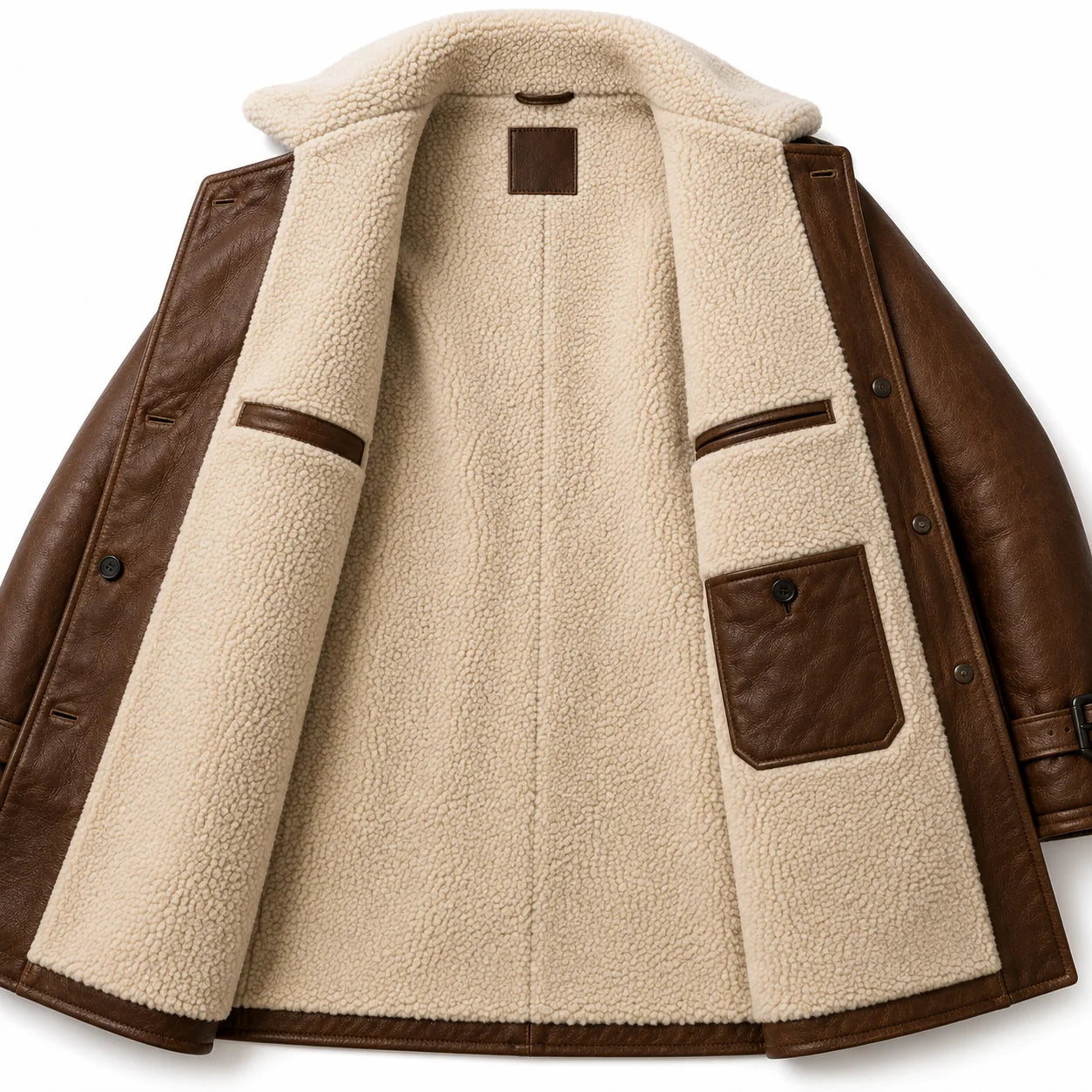
A men's shearling leather trench coat combines a genuine leather exterior. Typically, cowhide or lambskin with a natural shearling interior where the wool side faces inward against the body. The wool fibers trap warm air, regulate moisture, and provide insulation effective between 10°F and 45°F without synthetic padding.
It is considered the warmest non-down leather outerwear available and functions as a premium cold-weather investment piece.
Most men figure out what shearling actually is the first time they wear it on a genuinely cold day.
It's not a liner sewn into the coat as an afterthought. Natural shearling is the whole skin of a sheep; leather on one side, dense wool on the other, processed together as a single material. That wool facing inward against your mid-layers creates a microclimate.
Your body heat stays inside the coat. Cold air doesn't get in. And unlike synthetic insulation that compresses and loses loft over time, natural shearling holds its structure for decades.
The exterior of this coat is 1.2mm full-grain cowhide. The interior is natural shearling with a 25mm wool pile depth. Together they sit at around 2.5mm total shell thickness; substantial in hand, but the wool-to-weight ratio means you're not carrying dead weight on your frame.
Brown shell. Natural cream-white wool facing. The contrast when you open the coat is exactly what you'd expect at twice this price.
The Warmth-to-Weight Ratio, Why Shearling Outperforms
There are three ways to build warmth into outerwear: synthetic insulation (down, Thin sulate), heavy wool, or natural shearling. Each has a different warmth-to-weight trade-off. Here's how they compare at equivalent garment weights:
|
Insulation Type |
Warmth Rating |
Weight (avg. coat) |
Effective Temp Range |
Longevity |
|
Natural Shearling |
★★★★★ |
2.8–3.5 lbs |
10°F – 45°F |
20–40 years |
|
Down (700 fill) |
★★★★☆ |
1.8–2.4 lbs |
15°F – 40°F |
5–10 years |
|
Synthetic Thinsulate |
★★★☆☆ |
2.2–3.0 lbs |
25°F – 45°F |
3–6 years |
|
Heavy Wool Blend |
★★★☆☆ |
3.2–4.2 lbs |
30°F – 50°F |
10–20 years |
|
Unlined Leather |
★★☆☆☆ |
2.0–2.8 lbs |
35°F – 55°F |
20–30 years |
Shearling wins on warmth-to-weight and longevity simultaneously. It's the only insulation type that improves with use rather than compressing and losing performance. A 20-year-old shearling coat, conditioned properly, insulates as effectively as it did when new.
The trade-off is weight and price. At $499, this coat sits at the entry point of serious shearling construction. It's not a budget coat. It's not meant to be.
Construction Specs
Full Material & Build Breakdown
|
Spec |
Detail |
|
Shell Hide Type |
Full-Grain Cowhide |
|
Shell Thickness |
1.2mm |
|
Shell Weight |
4.2 oz / sq ft |
|
Lining Type |
Natural Shearling (Wool-Side In) |
|
Wool Pile Depth |
25mm |
|
Total Shell Thickness |
~2.5mm |
|
Color — Exterior |
Brown |
|
Color — Interior |
Natural Cream / Off-White Wool |
|
Closure |
Double-Breasted, 6-Button Front |
|
Collar |
Wide Peak Lapel with Shearling Underside |
|
Belt |
Adjustable D-Ring Waist Belt |
|
Pockets |
2 Slash Exterior (shearling-lined) + 2 Interior |
|
Length |
Knee-Length (approx. 42–44") |
|
Hardware |
Antique Brass Buttons |
|
Fit |
Structured, Regular-to-Relaxed |
|
Sizes |
XS – 4XL |
|
Coat Weight |
approx. 3.0–3.4 lbs |
The shearling-lined exterior pockets deserve a specific mention. Your hands sit inside natural wool when the coat is worn open or closed. That's not standard on shearling coats in this price bracket. Most line pockets with synthetic fabric to cut costs. It matters on a 20°F morning.
How to Style a Men's Shearling Leather Trench Coat
Shearling has its own visual weight. The coat makes a statement before you've done anything else, which means the rest of your outfit should stay clean and controlled.
Cold-Weather City Dressing
Black shearling trench over a charcoal turtleneck, dark slim trousers, and black leather Chelsea boots. That's the complete look. No scarf needed. The shearling-underside collar, when turned up, covers the neck completely. Belt cinched, coat closed at the double-breasted front. You will not be cold. You will not look like you're wearing a puffer jacket.
Smart-Casual with Layers
Wear it open over a heavyweight flannel shirt and dark raw denim. The brown exterior reads sharp against casual base layers in a way a wool overcoat doesn't. It adds visual edge without looking overdressed for a weekend context.
Add leather boots with a lug sole, and the proportions work correctly.
Formal, Business to Evening
Over a black suit or dark navy tailored trousers and a blazer. The structured shoulders of the cowhide shell maintain formal silhouette integrity even with the shearling interior adding bulk. Keep the lapels wide and open at the top. The wool underside frames the collar of a dress shirt cleanly.
Fit Guide: Shearling Adds Interior Volume
The shearling interior changes the fit equation compared to a fully lined standard trench. The 25mm wool pile depth adds approximately 8–12mm of interior circumference per side. It means you'll feel the coat sitting slightly closer against mid-layers than the exterior shell dimensions suggest.
Practical guidance:
- Slim builds: Size up one from your standard outerwear size. The shearling fills the interior effectively. True-to-size will feel tight across the chest when layering.
- Athletic builds: Size up one, potentially two. The structured shoulders are fixed; the adjustable belt compensates at the waist.
- Broader frames: Size up one to two. Wear open for the best silhouette — the wide lapels and shearling contrast create visual interest without the belt.
If you're between sizes, go up. You can belt the waist tighter. You can't add room to a leather shell.
Shearling Care, What Actually Matters
Natural shearling requires slightly more attention than unlined leather. The wool interior needs occasional maintenance in addition to the exterior hide care.
Exterior (Full-Grain Cowhide Shell):
- Condition the leather shell every 6 months with a colorless leather conditioner.
- Wipe dry immediately after rain. Do not let water soak through to the shearling.
- Apply leather protector spray at the start of each cold season.
Interior (Natural Shearling Wool):
- Air the coat after heavy wear. Shearling absorbs body moisture and needs to breathe.
- Brush the wool pile gently with a soft bristle brush to restore loft if it flattens.
- Never machine wash or tumble dry. Spot clean only with cold water and mild soap.
- Store in a breathable garment bag. Shearling needs airflow to prevent odor buildup.
Storage:
- Wide padded hanger only. The coat's weight on a wire hanger deforms the shoulder structure.
- Cool, dry location with airflow. Never compress in storage. Shearling recovers from wear but not from sustained compression.
Who This Coat Is For
Not everyone needs a shearling trench. Be honest with yourself about where you live and how you dress.
This coat is the right buy if:
- You're in a climate that sees sustained temperatures below 35°F from November through March (Northeast, Midwest, Mountain West, Pacific Northwest).
- You want one coat that covers formal, business, and weekend contexts without switching.
- You've already owned a standard leather trench and want the cold-weather upgrade.
- You're buying outerwear you intend to own for 15–20 years.
A standard leather trench is the better choice if:
- Your winters are mild (Southern US, coastal California).
- You prefer a lighter coat you can wear nine months of the year.
- You're new to leather outerwear and want to start at a lower price point.
For the milder-climate version, see our Men's Black Leather Trench Coat at $249.
Frequently Asked Questions
What is a shearling-lined leather trench coat?
What is a shearling-lined leather trench coat?
A shearling-lined leather trench coat has a genuine leather exterior; typically, cowhide or lambskin with a natural shearling interior. Shearling is sheepskin processed with the wool still attached, with the wool side facing inward. It provides natural insulation, moisture regulation, and warmth without synthetic padding.
How warm is a shearling leather trench coat?
How warm is a shearling leather trench coat?
A natural shearling coat with 25mm wool pile depth provides effective insulation between 10°F and 45°F. This places it above down-filled coats in sustained cold and significantly above unlined leather or wool-blend overcoats in the same weight class.
Is natural shearling the same as faux shearling?
Is natural shearling the same as faux shearling?
No. Natural shearling is genuine sheepskin with the wool still attached, processed as one material. Faux shearling is a synthetic textile designed to mimic the look of wool. Natural shearling regulates temperature bi-directionally (warm in cold, less stuffy in mild weather), breathes naturally, and lasts decades. Faux shearling compresses over time and does not replicate the thermal performance of real wool.
Will a shearling leather coat work in wet weather?
Will a shearling leather coat work in wet weather?
The full-grain cowhide exterior has natural water resistance. However, sustained rain saturation will eventually reach the shearling lining, and wet shearling takes significant time to dry. For wet climates, treat the exterior shell with a leather protector spray seasonally. Avoid prolonged rain exposure. After any heavy moisture exposure, dry at room temperature, never near a heat source.
How should I size a shearling leather trench coat?
How should I size a shearling leather trench coat?
Size up one from your standard outerwear size. The 25mm natural shearling pile adds interior volume. Wearing true-to-size will feel restrictive across the chest when layering. Athletic builds should consider sizing up two. Full size chart available on the listing; measure your chest and reference it directly.
Can a shearling trench coat be dry cleaned?
Can a shearling trench coat be dry cleaned?
No. Do not dry clean shearling. The chemical solvents in standard dry cleaning damage both the leather shell and the wool pile. Spot clean the interior with cold water and mild wool-safe soap. For the leather exterior, use a dedicated leather cleaner. For deep cleaning needs, take the coat to a specialist in leather and shearling garment care.
How long does a natural shearling coat last?
How long does a natural shearling coat last?
With proper care, conditioning the exterior twice yearly, brushing the wool interior, and correct storage, a natural shearling coat lasts 20–40 years. The wool pile may compress slightly over time with heavy wear and can be restored with brushing. The leather shell ages in the same way as any full-grain cowhide, developing character rather than deteriorating.
The $299 Investment, Framed Correctly
Five hundred dollars on a coat is not a real decision. Here's the honest framing. A mid-range synthetic insulated parka at $150–$200 lasts approximately 4–6 years before the insulation compresses, the shell delaminates, or the zipper fails. Replace it twice over a decade. You've spent $400 on coats that are now in the landfill. A down puffer at $300–$400 from a major outdoor brand lasts 7–10 years with careful cleaning. The downshifts and clusters. The shell wears through at stress points. It's not built to last 20 years, and it wasn't designed to be. This coat at $299 is engineered to outlast all of those cycles. The full-grain cowhide shell has no synthetic delamination risk. The natural shearling doesn't lose loft permanently. The hardware is replaceable. The stitching is repairable by any leather specialist. In cold-climate US markets where you're wearing serious outerwear 4–5 months per year, $299 divided across 20 years is $15 per year. Per coat. For the warmest, sharpest outerwear you'll own. That's not luxury spending. That's efficient purchasing.
Share